What I live with
Three words I was handed, and what they actually feel like
Fibromyalgia, POTS and Dysautonomia. This is not the full symptom list. It is the part of it that lives in my body.
I'm writing this as someone who lives with these conditions, and as someone whose whole working life was built on educating and training others. When my health changed, my instinct was the same one I'd always had. I needed to understand what was happening to me. I had the tools to research and the background to make sense of what I found, and I know that is not the case for everyone.
Every one of these conditions has a symptom list as long as your arm, and you can find it on the internet in under a minute. I am not going to write it out again. What I can tell you is which parts of that list live in my body, because that is the thing I could not find anywhere when I went looking.
So each one below gets two short pieces. What it is. And what it is not, because that is the part people get wrong.
What they feel like in me comes further down, in a section about my days. I have not split that part up by condition. The symptoms overlap, and my body has never once checked which label a thing is supposed to belong to.
If you are here because someone you love has been handed one of these words, the "what it is not" pieces are written for you.
Fibromyalgia
What it is
A long-term condition of widespread pain through the body, deep fatigue, and a particular kind of mental fog that most of us call fibro fog. The current understanding is that the trouble sits in the way the nervous system processes pain signals. The volume is turned up, so the body feels pain more intensely, and in more places, than it otherwise would.
What it is not
It is not being tired. Everybody is tired. It is not being unfit, and it is not something a good night's sleep fixes, because broken sleep is part of the condition rather than the cause of it. It is not an autoimmune disease, although you will hear it being called one. And it is not imagined, though a great many of us have been told that it is.
POTS
What it is
POTS stands for Postural Orthostatic Tachycardia Syndrome, and the name is a plain description of the thing itself. A racing heart on standing. It affects the autonomic nervous system, the part of the body that quietly runs everything you never think about, like heart rate, blood pressure, digestion and temperature. When someone with POTS stands up, the body does not manage the change the way it should, and the heart races to make up for it.
What it is not
It is not fainting now and again. It is not being unfit, and it is not forgetting to drink enough water. And it is not anxiety, although a pounding heart is the thing anxiety is best known for, and that mix up costs people years before anybody measures it properly. It is measurable, which is the part I wish more people knew. A heart rate that climbs by at least thirty beats a minute within ten minutes of standing, without the blood pressure dropping to explain it.
Dysautonomia
What it is
Dysautonomia is the family name. It covers any condition where the autonomic nervous system is not doing its job. POTS is one form of it, which means POTS sits underneath dysautonomia rather than beside it. That was the piece that made everything else make sense to me.
What it is not
It is not a single diagnosis. Nobody is told they have dysautonomia and sent home with only that. And because the autonomic nervous system touches almost everything, it is not tidy. It shows up differently in different people, which is a large part of why it takes so long for anyone to put a name to it.
A word you will hear a lot
Comorbidity
A comorbidity means having more than one condition at the same time. It is a word you hear constantly in this world, because fibromyalgia, POTS and other forms of dysautonomia so often turn up alongside one another. One rarely arrives alone. Understanding that was a quiet relief for me, because it made the bigger picture make sense instead of feeling like a scattered list of unrelated problems.
And three more, while we are here
A flare. A stretch of days where everything is louder and worse for no reason anyone can point at. Pacing. Spending your energy deliberately rather than spending it all on Monday. Orthostatic intolerance. The formal way of saying that being upright is the problem.
Why I stopped collecting names
Knowing what I know now about that umbrella, I would not be surprised if there is more going on in my body than the two names I have been given. There probably is.
I have stopped asking.
I want to be careful how I say that, because it is a choice I made for myself and it is not advice for anybody else. For a long time, every new test and every new name felt like it might be the one that finally explained everything. What I found was the opposite. Each new label added weight. More appointments, more paperwork, and a little more of me handed over to being unwell. At some point I realised I was collecting names for a body I had to live in either way.
So I changed what I go after. Instead of chasing another diagnosis, I take one symptom at a time and I work on that one thing. If something makes a difference, I keep it. If it does not, I give it a fair go, and then I let it go and move on.
My doctors are still my doctors. If something new or frightening turns up, I have it looked at properly. This was never about stepping away from medical care. It is about not needing a longer list of names before I am allowed to be taken seriously, including by myself.
A day in this body
When people ask me what this feels like, I ask them if they remember having the flu. Then I tell them to take away the sore throat and the snotty nose, and keep everything else. Aching all over, heavy, weak, foggy, generally unwell. That, without an infection, and without it ending.
What follows is in three parts. What my days were like at my worst, what an ordinary day looks like now, and what has not changed. It is my story, and not a path for anybody else.
When I was at my worst
I would wake up already tired. Not the tiredness of a bad night. The tiredness of having done a full day of physical work before my eyes were open.
The worst day I remember, it took me over four hours to shower. Start to finish. I kept having to stop and lie down and rest, then go back, then stop again. When it was finally done I was too spent to get dressed. I got back into bed.
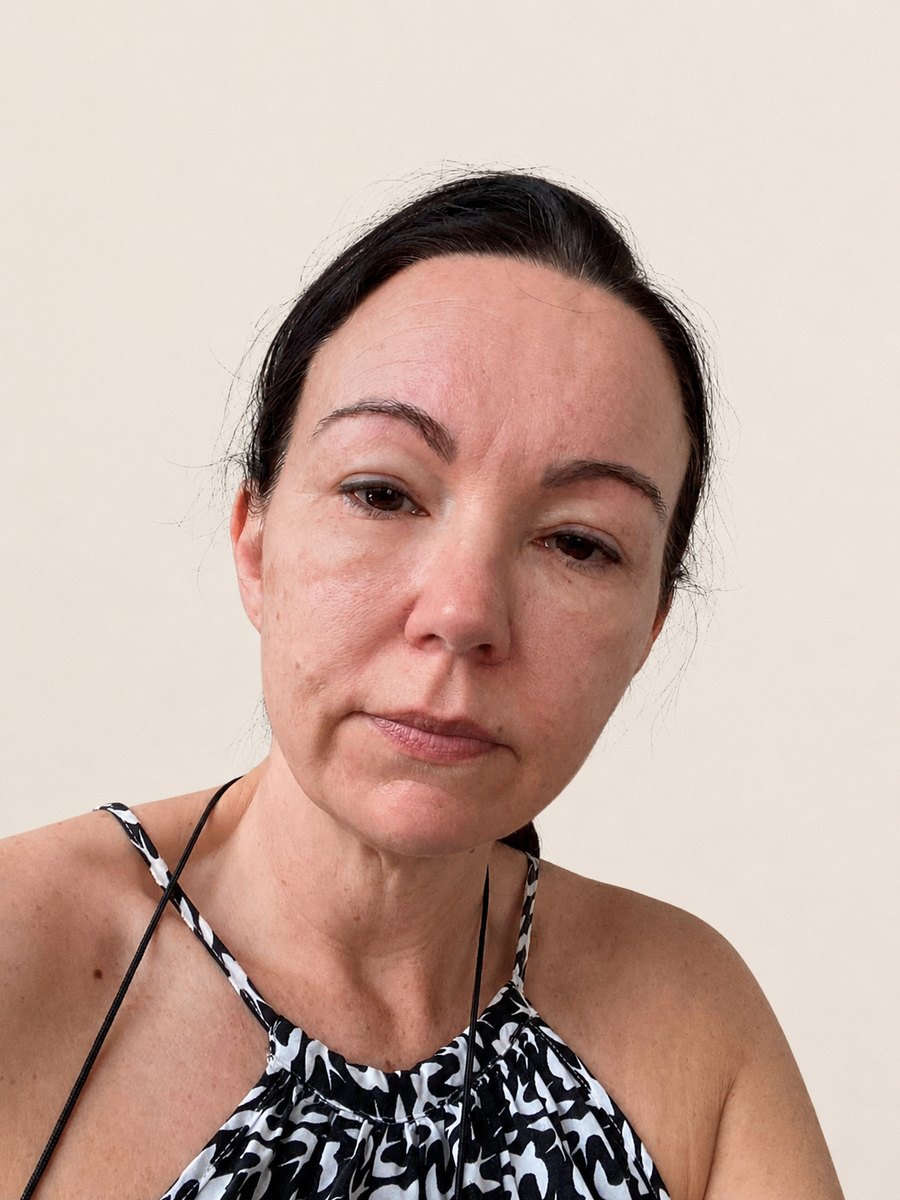
For over two years I could not wash my own hair. I had a standing appointment at a salon, and someone else had to drive me there, because I was on too much medication to drive myself.
Standing was its own problem. If I got up too fast everything went black and I would go down, and there was no warning in it. I learned to stand slowly and hold on to something, and to put myself somewhere I would be safe if I did pass out.
The morning after a foot surgery my son brought me a coffee and set it down beside the bed. I reached for it and my hand did not close. The cup fell and broke on the floor. That was how I found out I had lost my grip.
Clothing hurt. Not rough clothing, ordinary clothing sitting against my skin. The pain moved around, deep aching in some places, burning and stabbing in others, often my feet and my toes. Noise and light and smells and crowds wore me out all on their own.
I could not eat. One bite and I would feel sick for hours. I was assessed as malnourished and anaemic, and I became very underweight. I find that ironic, because in my late teens and twenties I was morbidly obese. I had gastric surgery, and over the years several operations to remove the excess skin, more than a full body lift all up. And then I could not keep weight on at all.
By three in the afternoon I was done. Not tired. Done. Nothing left, lie down.
Then the nights. I could sleep for hours and wake as though I had not slept at all, and getting comfortable enough to sleep in the first place was its own fight, because there was no position that did not hurt.
It was the darkest stretch of my life. I have always been careful not to say that I was depressed, but looking back, I can see there was an element of depression in it.
What a day looks like now
I do not set an alarm. I know how fortunate that is. There is no nine to five waiting for me, so I let my body wake up when it has finished, and I keep the room properly dark so that it can.
I have become very routine oriented, and the routines are all built around my health. The first hour is deliberate. Before anything else I have a small morning shot, a few things mixed together for my gut, followed by a glass of filtered water, so that is the first thing my body meets for the day.
Then I make up what I call my medicine water. It is the drink bottle everyone always sees me carrying. My salts and my minerals go into it, and I sip at it right through the day instead of taking capsules, which I have never managed well. Small amounts, all day long, rather than everything at once.
Then I take an hour with God before anything else happens. I read my bible, I pray for people, I sit with our Creator. That hour has done more for me than I know how to explain.
After that the day varies. I can do housework now, which sounds like nothing until you have spent years unable to. I can drive again.
Around four or five in the afternoon I take medication that means I am not driving or operating anything for the rest of the day. So I do not drive at night, and I do not generally go out at night. If there is a wedding or a birthday or something I want to be at, I plan my way to it. There were years when the answer to every invitation was no. Now the answer can be yes, if I build the week around it.
Mondays I do not leave the house. Monday resets my home and plans my week, and if there is something on later in the week, Monday is when I work out what I need to do to be able to go to it.
The thing that changed most is a question I ask myself.
What can I do today to help tomorrow Carla have a better day?
I know roughly what time I am going to run out, so I get things ready before I do. Bottle on the bench, everything that goes into it lined up beside it, sorted the night before. Then I wake up already a step ahead, with a task to finish rather than a whole job to face, and that is very often the difference between it happening and not happening. And I get to thank last night Carla.
A while back I was on the couch after dinner watching a documentary, and I noticed I was folding washing. I stopped halfway through the pile. I had not folded washing after dinner in about five years. That was always a morning job, because by the evening there was nothing left of me. It was a small thing. It was also the moment I knew something had shifted.
What has not changed
I still have mornings where I wake up and think, what did I do yesterday, I feel like I have been hit by a bus. They are further apart now, but they still come.
I still crash in the evenings. What changed is the hour. My day used to end at around three in the afternoon. Now I can often get to six or seven, and sometimes eight at night.
I still stand up and go black. It is not the falling over it used to be. My head goes dark, I hold on to something, close my eyes, brace, and wait for the blood to come back. Then I am alright.
I still get restless legs. Nausea still arrives out of nowhere, less often now, but with no warning at all.
I still get the fog, and this is the one I feel most, because of what I used to do for a living. In my clinical days I could walk up to someone, look at their skin, and talk the whole thing through on the spot. No notes, no preparation, straight off the top of my head. All of that knowledge is still in me. What has gone is being able to reach it instantly. These days, if I am helping a clinic owner work something through, I need time to prepare. I write it down, I map it out, I go through it slowly, and then I can deliver it properly. I can still do the work. I need a run up to it that I never used to need.
So I have built scaffolding around it. My phone and my calendar are full of reminders, so the remembering does not have to happen in my head. It means I am not letting other people down, and I am not letting myself down.
My body still does not regulate its own temperature. Too hot and the nausea comes, and sometimes I am sick. Too cold and I shiver and shatter and cannot get warm again for anything. Through the cooler months I am the most heavily dressed person in any room, in layers, with a linen shawl in my handbag in case I need something extra over my shoulders. My neck and my shoulders are the worst of me.
And there is one my GP had to name for me, because I had no idea what I was looking at. Superficial vein thrombosis, a clot in one of the small veins near the surface, usually in my wrists or my hands. The vein swells up hard and inflamed and it is extremely painful, and a day or two later it settles and leaves a bruise behind for days. I have had it more than once. It arrives without warning and I still have not worked out what sets it off. Of everything on this page, it is the one I would most like an answer to.
I sleep more consistently now, and I am heavily medicated in order to do so. I no longer need opioids for pain, which I was on constantly. I still need benzodiazepines to sleep, and that is something I would like to work on.
And I am still weak. I used to train hard and lift heavy, and going from a body with real muscle on it to one that had wasted away is a loss I am still working back from.
None of this is a finished story. It is a better one.
Why sharing what helps us matters
Here is something I believe deeply. The more of us who live with these conditions and share what genuinely helps us, the more our health professionals learn, and the more they can pass on to the next person who walks through their door.
In my Clinic years I learned to truly listen to my clients, to absorb what they told me about their lives, and to hold onto it. So when someone else came along facing something similar, I had a little piece of wisdom to offer them, gathered from someone who'd walked it before. That habit of listening and passing on is one of the reasons this website exists.
So I'd gently encourage you. As you find what supports you, share it with your trusted practitioners, your GP, your specialists, your physiotherapist, your exercise physiologist, your occupational therapist. Bring your experience into the conversation. Not in place of their expertise, but alongside it. That is how the whole community grows wiser together.
You don't have to work it all out alone
If you have been handed one of these words and you are frightened, I understand. Learning what you are dealing with is the first step toward feeling steady again. Knowledge really is confidence.
I gathered what I have learned and put it here so it might reach someone who needs a gentler starting point than I had. If that is you, I'm so glad you found your way here.
Understanding is where the footing begins.
There is more than I put on a page
I do not publish everything. Some of what I live with is personal, and there are parts I would rather say to a person than put on a website for anyone to read.
If you live with fibromyalgia, POTS or dysautonomia and you want to talk to me properly, come and find me. Choose “Living with fibromyalgia, POTS or dysautonomia” when you write, so I know what you are asking, and I will answer you myself.
Everything here is shared from my own lived experience and my background as an educator. It is general information only, not medical advice, and it isn't a diagnosis or a treatment plan. What my body does is not what yours will do. Your doctors and specialists know you and your body, and they are the ones to guide your care.